

8 aug 2026 #jasonarday #LBC #uk
The fantasist professor Jason Arday has finally resigned.
What started as a plagiarism row has escalated into a full-blown saga, as fantastical claims made by Cambridge’s youngest black professor came under scrutiny. James Hanson runs you through the story.
The University of Cambridge has confirmed it will continue investigating a professor who resigned amid a plagiarism row, adding that findings will feed into a review of the process for appointing senior academic roles.
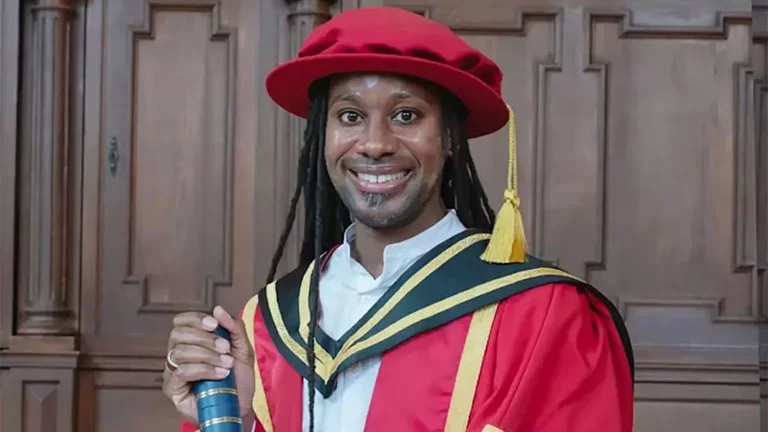
Professor Jason Arday quit his high-profile role at the prestigious university on Wednesday after it launched a probe into his “academic qualifications and honorary appointments”.
Senior dons at Cambridge are understood to be circulating a letter calling for an inquiry into the processes around his appointment, according to the Guardian.
Prof Arday’s resignation followed a series of media reports alleging he plagiarised his PhD thesis – completed at Liverpool John Moores University – and other research.
Further questions were asked in the press about the truth of other claims made by the professor of sociology of education, who became Cambridge’s youngest black professor in 2023, including saying that he ran 600 miles in six days and that he had raised £5.5 million for charity.
In a statement on Friday, Cambridge said: “As has been widely reported, Jason Arday has resigned from his post at the university with immediate effect.
“Regardless of this, and for clarification, the university will continue to investigate the circumstances around Jason Arday’s appointment and tenure. The findings will feed into a review of the process for the appointment of senior academic roles.
“In addition, and as previously stated, the university’s Research Policy Committee will review the misconduct in research policy.”
Jesus College said previously that it was launching its own process in relation to the allegation.
An investigation at Liverpool John Moores University cleared Prof Arday of wrongdoing.
One of the academics calling for an inquiry, Priyamvada Gopal, told the Guardian: “An independent investigation must scrutinise how such an early-career appointment to a very senior and prestigious professorial chair was made and what both the faculty of education and university management may have got very badly wrong.”
The professor of postcolonial studies at Cambridge’s English faculty added: “Whatever the results of any investigation, the university bears no little responsibility for the grotesque racism which this whole business has unleashed, and for the harm done both to the individual in the line of fire, to black academics as a group, and the broader field of critical race studies.”
In the wake of Prof Arday’s resignation, academics said his case will provide those who condemn diversity and equality initiatives with a “weapon” and put off other black scholars from the field.
Alan Lester, professor of historical geography at the University of Sussex, said: “The tragedy is that this case now provides the far-right racists who condemn any equalities and diversity initiatives with a weapon that they will wield egregiously.”
Kehinde Andrews, who was until recently professor of black studies at Birmingham City University, told Sky News: “No one’s handing out favours to black people in higher education, and that idea is deeply dangerous and deeply racist.
“There is a whole campaign to get more black professors in, but the experiences that we have tend to be horrendous and it does put people off from trying to even get into these places in the first place.”
Prof Arday said in his open resignation letter that the “only way to bring this chapter to an end is to step away”.
In the letter addressed to colleagues published on the Good Law Project’s website, he said: “This decision should not be interpreted as a loss of faith in scholarship or in the values that first brought me to Cambridge.
“Nor should it be mistaken for an acceptance of the narratives that have surrounded me.
“It is simply the decision of someone who has reached the limits of what any person should reasonably be expected to endure.”
His memoir, Great And Unfortunate Things, is due to be published by Simon & Schuster later this month.

17 aug 2026 The Daily T Podcast
In Monday’s episode of The Daily T, Camilla Tominey and Tim Stanley reflect on the media fallout and institutional hypocrisy surrounding the death of Jason Arday, a former Cambridge professor.
Tim discusses going to confession at the weekend to examine his conscience from covering the story and admitting to at times needing to remember that there is a human behind the story.
Plus, they debate the media’s right to scrutinise public claims, and question the extent of Cambridge University’s responsibility for the way Mr Arday was used as a poster child – only to be abandoned.


The chancellor of Cambridge University today has condemned the “racist feeding frenzy” around Jason Arday. Arday was found dead on Friday after a relentless slew of articles querying the veracity of his academic work and life story. Was it really in the public interest to scrutinise every aspect of his life – even after he’d resigned from his post? Or did the controversy around Jason Arday’s appointment become a bloodsport for the British media? Would he have faced anything like the same level of hostility if he had been white?
.


16 aug 2026
On Friday, Jason Arday was found dead in South London.
The BBC and other institutional actors, such as the Mayor of London, Sadiq Khan, chose to insinuate that the blame lies with the messenger.
Cambridge University, which hid the truth and engaged in a cover-up, has been largely free from criticism.
In this interview, Nathan Cofnas, who broke the story, discusses how the fraud was an open secret on campus, how fear of being labelled racist stopped people from telling the truth, and how elite institutions have come to mirror moral orthodoxies rather than the pursuit of truth.


30 aug 2026
Nathan Cofnas is the race realist academic who was instrumental in exposing Jason Arday as a non-realist academic. J.K. Rowling just called him “racist” on Twitter.
I’m a big fan of J.K. Rowling. She’s resolute in her resistance to gender ideology even though it hurts her financially, subjects her to vitriol and puts her at risk. You might think J.K. Rowling would have some solidarity with another person who’s been hauled over the coals for promoting scientific realism over cultural norms, but no. He’s t̶r̶a̶n̶s̶p̶h̶o̶b̶i̶c̶ “racist”.
This exposes her blind spot. Gender ideology is where her realism stops. When it comes to race realism, she turns into Owen Jones.
Which is a shame. I’ve seen other TERFs stand up for, if not race realism, then at least nationalism. There are parallels between the way that men are allowed to “identify” as women and the way that Rwandan men are allowed to identify as Welsh choirboys.
But when it comes to Cofnas, many TERFs are saying that human sex is dimorphic, whereas race is nebulous and hard to define.
Nebulous? Maybe. But if I’m walking around London, half the time I can’t tell if a person is a man or a woman. But I immediately know if I’m at Wimbledon or if I’m at the Notting Hill Carnival. If a big bunch of black “yoot” gets on my train carriage, I can tell with my eyes shut. If I drive through a Muslim area, there are usually a few tell-tale signs (written in Urdu).
The ratio of males to females is pretty constant around the world, but there are huge discrepancies in what those areas are like. Calcutta and Lagos are not like Durham or Bergen. I suspect there may be factors other than masculinity and femininity guiding behaviour at the population level.
I understand that it’s a taboo with the potential to destroy careers, and I also understand that there are easy get-outs. In-group variance is greater than inter-group variance. Any differences at the group level don’t mean that an individual will have any particular traits. I firmly believe that a man from the Horn of Africa can be intelligent and civilised, and I look forward to science proving me correct by one day finding one who is.
But the weakness of the attacks on Nathan Cofnas is revealing. Nick Ferrari could only accuse him of “causing distress to a black student”. This, in itself, was seen as reason enough to shut down anything that Nathan Cofnas might say.
But if we’re going to end all academic work that might cause distress, why not scrap the theory of evolution? It distresses creationists. Perhaps the cardinals were correct to condemn Galileo for presenting a heliocentric model, because the heliocentric model had distressed them?
Academia’s credibility has taken a beating over the last couple of months, but as the taboos around race realism evaporate, Cofnas may end up resurrecting it – and finally be appointed “Head of Eugenics & Race Science at Harvard”.

7 aug 2026
“It’s the kind of story that belongs in a sappy Hollywood biopic or drama.”
The Times’s Sarah Ditum unpacks everything in Jason Arday’s Memoir, Great And Unfortunate Things.

17 aug 2026 Novara Live – NEW episodes every weekday 6pm UK
Professor Jason Arday has been found dead at his home, following intense scrutiny of his personal life and academic career by the media.
This episode contains discussions of suicide. If you are affected by any of the issues raised, don’t hesitate to reach out to Samaritans: https://www.samaritans.org/how-we-can…
00:00 Intro
00:24 Jason Arday Found Dead
28:37 Reflection On Novara’s Coverage Of Arday


16 aug 2026 #JasonArday #Plagiarism
Jason Arday was once celebrated as the youngest Black professor in the history of the University of Cambridge. In 2026, his career became the centre of a major controversy involving plagiarism allegations, questions about his academic record, Cambridge’s response, and his eventual resignation.
Then, on 14 August 2026, Jason Arday was found dead at his home in south London, aged 41.
This documentary examines the Jason Arday story from the beginning: his extraordinary rise through British academia, his 2023 Cambridge appointment, the allegations surrounding his 2015 PhD thesis and published research, questions about his public claims, the role of Nathan Cofnas, Cambridge’s changing position, the Times Higher Education investigation that was reportedly stopped after a legal letter, and Arday’s resignation on 5 August 2026.
Most importantly, this video separates what is established from what was alleged.
Liverpool John Moores University had previously investigated Arday’s thesis and concluded that the citation issues represented honest and reasonable error. Cambridge later opened its own investigation, but that process had not reached a public conclusion before Arday’s death.
Police have described his death as unexpected and not suspicious.
The unanswered questions surrounding one of Britain’s most controversial academic stories of 2026.
Watch to the end for the key question: what was actually established, what remained an allegation, and what was never investigated to a conclusion?

2 uur geleden in première gegaan
How a tale of two teachers became a parable of our times
This week, Colin tells a tale of two teachers, separated by 40 years but bound by one unavoidable question: why do those in power reward the story they want to believe over the truth?
Jason Arday, the youngest Black professor ever appointed by Cambridge, staked his reputation on a Homeric struggle against adversity. That story has since unravelled in the most devastating fashion.
Contrast this with Ray Honeyford, a white Bradford headmaster who had a hardscrabble childhood. He wrote one honest article criticising multiculturalism in 1985 and was hounded out of his job.
Colin explores why one man was lionised for saying what people wanted to hear, while the other was destroyed for telling the truth.


Heeft 12 uur geleden live gestreamd
Dr. Benedict Beckeld and Dr. Stelios Panagiotou, as philosophers and former academics, discuss the recent Jason Arday case and its implications for academia more broadly.
This is the first livestream hosted by either of these two channels. Join us for a hopefully interesting experiment!
