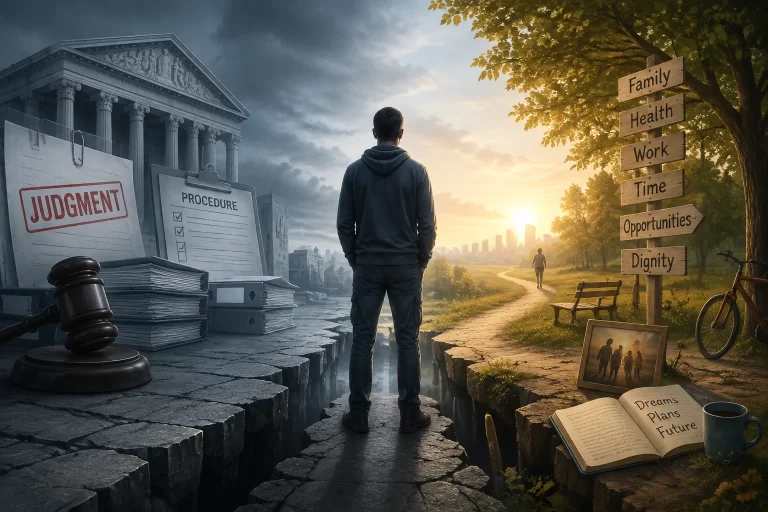
Rechtvaardigheid betekent niet alleen dat er een oordeel wordt gevormd. Ware rechtvaardigheid vraagt ook het vermogen om te erkennen wanneer een oordeel niet langer overeenstemt met de werkelijkheid — en de wijsheid en menselijkheid om het te herstellen.
Justice is not only the ability to make a judgment. It is the ability to recognise when a judgment no longer reflects reality and to have the wisdom and humanity to correct it.

The deepest challenge of justice is preserving the connection between judgment and reality.
Page Description
A judgment can change a life forever. This page examines what happens when a legal conclusion becomes disconnected from reality, and why justice needs the courage to correct itself.
1 When a Judgment No Longer Reflects Reality
A judgment is meant to bring clarity, truth, and justice. But what happens when a judgment no longer reflects reality?
The consequences can be profound. A person’s freedom, reputation, relationships, education, and future can be shaped by a conclusion that has become disconnected from the facts.
The greatest challenge for any justice system is not only to make decisions, but also to recognise when those decisions no longer reflect reality — and to have the wisdom and humanity to correct them.
How can a judgment become separated from reality, and what happens to the person standing in that gap?
The danger is not always created by people who lack intelligence or education. Sometimes the danger lies in what happens when expertise, authority, and institutional expectations become separated from personal moral responsibility.
Reality should come before judgment.
Wanneer een oordeel niet langer de werkelijkheid weerspiegelt
Een oordeel is bedoeld om duidelijkheid, waarheid en rechtvaardigheid te brengen. Maar wat gebeurt er wanneer een oordeel niet langer overeenkomt met de werkelijkheid?
De gevolgen kunnen ingrijpend zijn. Vrijheid, reputatie, relaties, opleiding en de toekomst van een mens kunnen worden bepaald door een conclusie die losgeraakt is van de feiten.
De grootste uitdaging voor elk rechtssysteem is niet alleen om beslissingen te nemen, maar ook om te erkennen wanneer die beslissingen niet langer overeenstemmen met de werkelijkheid — en de wijsheid en menselijkheid te hebben om ze te corrigeren.
Hoe kan een oordeel zich losmaken van de werkelijkheid, en wat zijn de gevolgen voor de mens die tussen beide komt te staan?
Het gevaar ontstaat niet altijd door een gebrek aan intelligentie of opleiding. Soms ontstaat het wanneer deskundigheid, gezag en institutionele verwachtingen loskomen van persoonlijke morele verantwoordelijkheid.
2 The Struggle Between Truth and the Stories We Choose to Believe
The challenge of keeping judgment connected to reality extends beyond individual cases.
It also concerns how societies remember the past, understand injustice, and preserve the truth.
Whether in a justice system, an institution, or a daily-life incident, the first essential step is always the same:
Make sure reality is established before conclusions are drawn.
A justice system has an essential role in protecting society and addressing wrongdoing. The deeper point is that justice must remain connected to its purpose: seeking truth and applying the law fairly, not creating harm by moving away from reality.
De spanning tussen waarheid en de verhalen die wij kiezen om te geloven
De uitdaging om oordelen opnieuw in verbinding te brengen met de werkelijkheid reikt verder dan individuele gevallen. Ze raakt ook aan de manier waarop samenlevingen omgaan met het verleden, onrecht begrijpen en de waarheid bewaren.
Of het nu gaat om een rechtssysteem, een instelling of een situatie uit het dagelijks leven, de eerste essentiële stap blijft altijd dezelfde:
Stel eerst de werkelijkheid vast voordat er conclusies worden getrokken.
Een rechtssysteem speelt een essentiële rol bij het beschermen van de samenleving en het aanpakken van wangedrag. Het diepere punt is dat gerechtigheid verbonden moet blijven met haar doel: het zoeken naar de waarheid en het eerlijk toepassen van de wet, en geen schade veroorzaken door afstand te nemen van de werkelijkheid.
Bryan Stevenson on the “Enduring Evil of Slavery” and Trump’s Attempt to Rewrite History
11 aug 2026 Latest Shows
We sat down with civil rights lawyer Bryan Stevenson, founder and executive director of the Equal Justice Initiative. In 2018, the organization opened the Legacy Museum in Montgomery, Alabama, to tell the history of millions of enslaved Africans who were abducted and trafficked across the Atlantic to the Americas by European powers, and to chronicle the legacy of slavery, racism, lynchings and segregation in the United States. The Legacy Museum has just opened its first international exhibition as part of the Edinburgh International Festival in Scotland.
A
E
3 The Human Tendency to Accept What Appears to Be True
Candid Camera Classic: Change Your Name!
A
E