Page Description
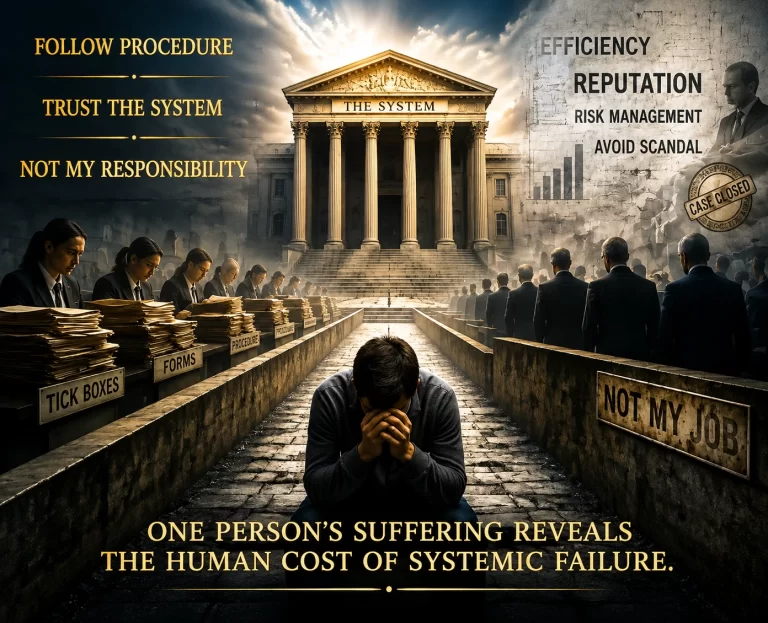
Behind many injustices are not only individual mistakes, but systems that fail to recognise the truth. Explore systemic dishonesty, institutional failure, and the human cost of ignored warnings.
How can systems develop patterns that allow serious failures to persist?
Throughout history, many failures were not caused by a complete absence of warnings, evidence, or concerned voices. Often, the information existed — but it was ignored, dismissed, or lost within structures where responsibility became divided and accountability became unclear.
Systemic failure rarely begins with one dramatic decision. It can develop through many smaller choices:
- following procedures without questioning them,
- protecting an institution’s reputation,
- avoiding responsibility,
- and accepting the suffering of individuals as an unfortunate consequence rather than a sign that something is fundamentally wrong.
The tragedy is not only that innocent people can suffer. It is that the systems created to protect them can sometimes become unable — or unwilling — to recognise their own failures.
The phrase “the banality of evil” describes a disturbing possibility: that serious harm can occur not only through deliberate cruelty, but also through ordinary people carrying out roles within a system without sufficiently questioning the consequences of their actions.
This page explores how systemic dishonesty, institutional self-protection, and the loss of personal responsibility can allow injustice to continue — and why the human cost is often paid by those who have the least power.
Hoe kunnen systemen patronen ontwikkelen waardoor ernstige tekortkomingen blijven voortbestaan?
Door de geschiedenis heen zijn veel mislukkingen niet ontstaan doordat er helemaal geen waarschuwingen, bewijzen of bezorgde stemmen waren. Vaak was de informatie aanwezig — maar werd deze genegeerd, terzijde geschoven of raakte zij verloren binnen structuren waarin verantwoordelijkheid verdeeld raakte en aanspreekbaarheid onduidelijk werd.
Systemisch falen begint zelden met één dramatische beslissing. Het kan ontstaan door vele kleinere keuzes:
- procedures volgen zonder ze ter discussie te stellen,
- de reputatie van een organisatie beschermen,
- verantwoordelijkheid vermijden,
- en het lijden van individuen accepteren als een ongelukkig gevolg in plaats van als een signaal dat er fundamenteel iets mis is.
De tragedie is niet alleen dat onschuldige mensen kunnen lijden. Het is ook dat de systemen die zijn opgericht om hen te beschermen soms niet meer in staat — of niet meer bereid — zijn om hun eigen tekortkomingen te herkennen.
De uitdrukking “de banaliteit van het kwaad” beschrijft een verontrustende mogelijkheid: dat ernstig leed niet alleen kan ontstaan door bewuste wreedheid, maar ook doordat gewone mensen binnen een systeem hun rol uitvoeren zonder de gevolgen van hun handelen voldoende in vraag te stellen.
Deze pagina onderzoekt hoe systemische oneerlijkheid, institutionele zelfbescherming en het verlies van persoonlijke verantwoordelijkheid ervoor kunnen zorgen dat onrecht blijft voortbestaan — en waarom de menselijke prijs daarvan vaak wordt betaald door degenen die het minste macht hebben.
1
2 Convictions: Cases That Reveal System Failures
Wrongful Convictions: Cases That Reveal System Failures
This powerful 60 Minutes documentary examines the devastating consequences of wrongful convictions and the failures that can allow them to happen.
The episode follows several stories, including people who spent decades facing the possibility of execution for crimes they did not commit. It also explores the personal struggle of those within the justice system who later question decisions that contributed to these outcomes.
Beyond the courtroom, the documentary looks at the long journey of healing. During a three-day healing programme, survivors confront the deep emotional wounds left by years of injustice. One powerful exercise uses a ceramic bowl as a symbol of what happens after trauma: the bowl is placed under a towel and broken with a hammer, then carefully glued back together. Although it can be repaired, the cracks remain — a reminder that some experiences leave lasting scars that cannot simply be erased.
This documentary shows that wrongful convictions are not only about legal mistakes. They are about human lives changed forever, trust broken, and the lasting impact of a system that failed to find the truth.
Onterechte Veroordelingen: Zaken Die Het Falende Rechtssysteem Blootleggen
Deze krachtige documentaire van 60 Minutes onderzoekt de verwoestende gevolgen van onterechte veroordelingen en de tekortkomingen die ervoor kunnen zorgen dat zulke situaties ontstaan.
De aflevering volgt verschillende verhalen, waaronder mensen die tientallen jaren leefden met de dreiging van executie voor misdaden die zij niet hadden gepleegd. Ook wordt de persoonlijke worsteling belicht van mensen binnen het rechtssysteem die later de beslissingen in vraag stellen die tot deze uitkomsten hebben bijgedragen.
Naast de rechtszaal kijkt de documentaire naar de lange weg naar herstel. Tijdens een driedaags herstelprogramma worden overlevenden geconfronteerd met de diepe emotionele wonden die jaren van onrecht hebben achtergelaten. Een krachtige oefening gebruikt een keramische kom als symbool voor wat er na een trauma gebeurt: de kom wordt onder een doek gelegd en met een hamer stukgeslagen, waarna de stukken zorgvuldig weer aan elkaar worden gelijmd. Hoewel de kom kan worden hersteld, blijven de barsten zichtbaar — een herinnering dat sommige ervaringen blijvende littekens achterlaten die niet zomaar kunnen worden uitgewist.
Deze documentaire laat zien dat onterechte veroordelingen niet alleen gaan over juridische fouten. Ze gaan over mensenlevens die voorgoed veranderen, vertrouwen dat wordt beschadigd en de blijvende gevolgen van een systeem dat er niet in slaagde de waarheid te vinden.
Wrongful Convictions | 60 Minutes Full Episodes

25 jul 2026 60 Minutes
0:11 30 Years on Death Row
15:55 Who Killed Louis Gladu?
29:41 Healing Justice (Part 1)
43:31 Healing Justice (Part 2)
The Glen Ford Case
The second case, “Who Killed Louis Gladu?”, starting at 15:55, shows how fragile the justice system can be when the facts that emerge from the interviews with those involved are taken into consideration.
De zaak Glen Ford
E
De tweede zaak, „Wie heeft Louis Gladu vermoord?”, die om 15.55 uur begint, laat zien hoe kwetsbaar het rechtssysteem kan zijn wanneer rekening wordt gehouden met de feiten die uit de verhoren van de betrokkenen naar voren komen.
3 A Legal Correction Is Not the Same as Moral Accountability
In the case of Glenn Ford, the fact that the system eventually released him after new information emerged does show that a correction mechanism existed. But that does not automatically answer the deeper questions:
- What happened during the decades before the correction?
- Why were warning signs not acted upon earlier?
- Who accepts responsibility for the consequences?
- Is it enough to say “the system worked” after an innocent person lost decades of his life?
When Dale Cox describes the outcome mainly as proof that the justice system worked, he is emphasizing the final correction. What is the concern about the entire chain of events that allowed the injustice to happen in the first place.
Regarding Marty Stroud, the contrast noticed is significant. A person can later express regret and still leave open questions about how such a conviction was pursued and maintained for so long. A balanced view requires holding both realities at the same time:
- people can make mistakes and later recognize them;
- but the harm caused to an innocent person remains real and cannot simply disappear because the system eventually changes course.
A reaction may come from hearing a disconnect: an interviewer asks about the human consequences, while the answer returns mainly to whether procedures were followed. That difference between procedural correctness and justice in substance is one of the central themes that I have been exploring on these pages.
In het geval van Glenn Ford toont het feit dat het systeem hem uiteindelijk heeft vrijgelaten nadat nieuwe informatie naar voren kwam, inderdaad aan dat er een mechanisme voor correctie bestond. Maar dat beantwoordt niet automatisch de diepere vragen:
- Wat gebeurde er gedurende de tientallen jaren vóór de correctie?
- Waarom werd er niet eerder gehandeld op basis van de waarschuwingssignalen?
- Wie neemt verantwoordelijkheid voor de gevolgen?
- Is het voldoende om te zeggen dat “het systeem heeft gewerkt” nadat een onschuldig persoon tientallen jaren van zijn leven heeft verloren?
Wanneer Dale Cox de uitkomst vooral beschrijft als bewijs dat het rechtssysteem heeft gewerkt, legt hij de nadruk op de uiteindelijke correctie. Jouw zorg gaat over de volledige keten van gebeurtenissen die ervoor heeft gezorgd dat het onrecht überhaupt kon ontstaan.
Wat betreft Marty Stroud is het contrast dat je hebt opgemerkt betekenisvol. Iemand kan later spijt betuigen en toch vragen onbeantwoord laten over hoe een dergelijke veroordeling tot stand kwam en zo lang in stand werd gehouden. Een evenwichtige beoordeling vereist dat men beide werkelijkheden tegelijkertijd onder ogen ziet:
- mensen kunnen fouten maken en deze later erkennen;
- maar de schade die een onschuldig persoon is aangedaan, blijft bestaan en verdwijnt niet eenvoudigweg omdat het systeem uiteindelijk van koers verandert.
Een reactie kan voortkomen uit het ervaren van een verschil: een interviewer stelt vragen over de menselijke gevolgen, terwijl het antwoord vooral teruggaat naar de vraag of de procedures zijn gevolgd. Dat verschil tussen procedurele juistheid en rechtvaardigheid in wezenlijke zin is een van de centrale thema’s die ik op deze pagina’s onderzoek.
The release of Glenn Ford demonstrated that the justice system had a mechanism for correction. But a system cannot only be judged by whether it eventually admits an error. It must also be judged by how long an innocent person was left to suffer, what warnings were ignored, and whether those responsible can truly confront the human consequences of their actions.
4 Wrongful Conviction at 17: The Human Cost of Systemic Failure
Keith Bush was 17 when he was convicted.
He spent 33 years in prison for a crime he always said he did not commit.
He Was Wrongly Convicted at 17. He Lost 33 Years. | THIRTEEN

23 jan 2026
A
A
D
E
N
5 When Systems Fail: Warnings Ignored, Consequences Paid
This one connects very well with the sequence developed earlier:
SYSTEM ERRORS → KNOWN WARNINGS → IGNORED EVIDENCE → TECHNICAL WARNINGS
because the section becomes another place where the reader sees that failure often develops over time rather than appearing suddenly.
5 When Authority Is Confronted With the Human Cost of Systemic Failure
Former Post Office boss Alan Cook challenged during inquiry over treatment of jailed sub-postmasters

A Moment of Accountability
This video captures a critical moment in the inquiry where Alan Cook, former Post Office CEO, faces tough questioning over the wrongful treatment and convictions of sub-postmasters. It highlights the urgent call for justice and the necessity of honest dialogue to address the deep harms caused by institutional failings.
Een Moment van Verantwoording
In deze video wordt een cruciaal moment in het onderzoek getoond waarin Alan Cook, voormalig CEO van de Post Office, wordt geconfronteerd met vragen over de onterechte behandeling en veroordelingen van Subpostmeesters. Het benadrukt de dringende oproep tot gerechtigheid en het belang van eerlijke dialoog om de diepe schade veroorzaakt door institutionele fouten aan te pakken.
In this short but powerful exchange during the Post Office Horizon inquiry, barrister Mr Henry questions former Post Office chief executive Alan Cook about the treatment of sub-postmasters who were accused, prosecuted, and in many cases imprisoned because of failures connected to the Horizon system.
The strength of Mr Henry’s questioning lies not only in the facts he presents, but in the contrast between the suffering of individuals and the decisions made by those at the highest levels of the organisation.
Behind every case file was a real person: someone who lost their reputation, their livelihood, their freedom, and often their health. The inquiry exposed how the focus remained on defending the system and protecting the organisation, while the voices of those affected were ignored.
This moment is powerful because it forces a person in authority to face a question that goes beyond technical failures:
What happens when an organisation protects itself instead of protecting the people it is responsible for?
The exchange reflects a central theme of this page: systemic dishonesty does not always appear as one person making one dishonest decision. It can emerge when institutions refuse to question their own assumptions, defend their own narrative, and allow individuals to carry the consequences of failures created by the system itself.
Wanneer gezag wordt geconfronteerd met de menselijke gevolgen van systeemfalen
In deze korte maar krachtige uitwisseling tijdens het onderzoek naar de Post Office Horizon-affaire ondervraagt advocaat Mr Henry de voormalige topman van de Post Office, Alan Cook, over de behandeling van sub-postmasters die werden beschuldigd, vervolgd en in sommige gevallen gevangen gezet als gevolg van de problemen rond het Horizon-systeem.
De kracht van de vragen van Mr Henry ligt niet alleen in de feiten die hij naar voren brengt, maar ook in het scherpe contrast tussen het lijden van individuele mensen en de beslissingen die werden genomen door degenen die de hoogste verantwoordelijkheid droegen binnen de organisatie.
Achter elk dossier stond een echte persoon: iemand die zijn reputatie, zijn inkomen, zijn vrijheid en vaak ook zijn gezondheid verloor. Het onderzoek heeft blootgelegd hoe de nadruk bleef liggen op het verdedigen van het systeem en het beschermen van de organisatie, terwijl de stemmen van de getroffen mensen werden genegeerd.
Dit moment is aangrijpend omdat iemand met gezag wordt geconfronteerd met een vraag die verder gaat dan alleen technische fouten:
Wat gebeurt er wanneer een organisatie zichzelf beschermt in plaats van de mensen te beschermen voor wie zij verantwoordelijk is?
Deze confrontatie weerspiegelt een centraal thema van deze pagina: systemische oneerlijkheid ontstaat niet altijd doordat één persoon één bewuste leugen vertelt. Zij kan ontstaan wanneer organisaties hun eigen aannames niet meer in twijfel trekken, hun eigen verhaal verdedigen en toestaan dat individuele mensen de gevolgen dragen van fouten die door het systeem zelf zijn veroorzaakt.
6 The Danger We Do Not See
36 Skewer Danger Prank
7 aug. 2016
Filmed in Montreal, Quebec Welcome to the world-famous Just for Laughs Gags channel, where we pull public pranks on unsuspecting Montreal residents and tourists.
This candid video shows how quickly people can become vulnerable when they do not see the danger in front of them. A situation that appears ordinary can suddenly change, reminding us how important awareness, protection and trust are in a world where hidden risks exist.
Het gevaar dat verborgen blijft
Deze candid camera-video laat zien hoe snel mensen kwetsbaar kunnen worden wanneer zij het gevaar voor zich niet herkennen. Een situatie die normaal lijkt, kan plotseling veranderen en herinnert ons eraan hoe belangrijk bewustwording, bescherming en vertrouwen zijn in een wereld waarin verborgen risico’s bestaan.