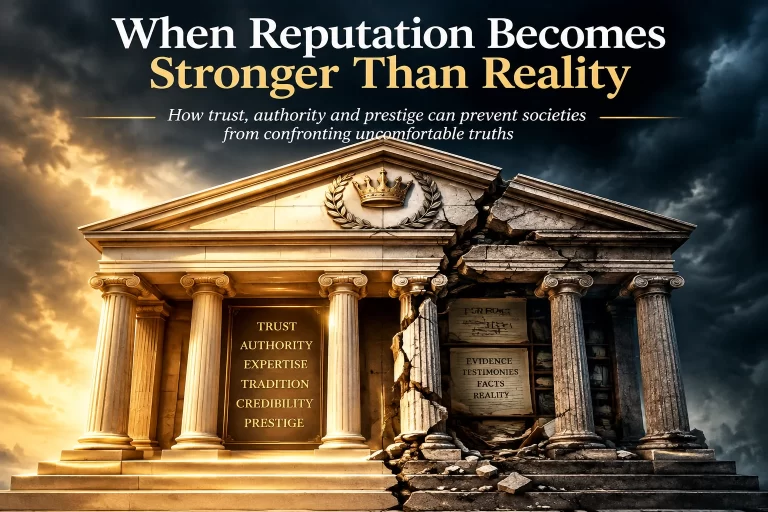
Hoe vertrouwen, gezag en reputatie samenlevingen ervan kunnen weerhouden ongemakkelijke waarheden onder ogen te zien
How trust, authority, and reputation can prevent societies from confronting uncomfortable truths

Page Description
How can respected people, institutions, and stories remain trusted when reality contradicts them? Discover the cost when reputation stands above truth.
Reputation is built on trust. It gives people, institutions, and stories the authority to be believed. But when that reputation becomes stronger than reality, uncomfortable truths can be ignored, warnings dismissed, and those who challenge the accepted story may not be heard.
Across science, finance, institutions, and personal narratives, these stories reveal a common pattern: the danger is not only in deception itself, but in the power of credibility to protect what should have been questioned.
“
:
“I
I
1 When Systems Fail: Reputation, Trust, and the Cost of Ignoring Reality
- Diederik Stapel → reputation in science protected false research.
- Stéphane Bourgoin → reputation as an expert protected a questionable personal narrative.
- Frank Abagnale → a remarkable life story became more powerful than scrutiny.
- Maria / A Strange Twist → a personal story became accepted as truth because it appeared authentic.
- The Salt Path → a celebrated story gained trust before serious questions emerged.
- Bernie Madoff → one of the most respected names in finance used reputation itself as a shield.
Grenfell Tower: The Collapse of Institutional Trust
The Grenfell tragedy revealed how official assurances, professional confidence, and institutional reputation can fail when warnings are ignored and reality is not confronted.
- Bernie Madoff = excellent fit for “When Reputation Meets Reality”
- The Salt Path = strong fit
- A Strange Twist = strong fit
- Grenfell Tower = meaningful connection, but probably belongs to the wider theme of institutional failure rather than the narrower reputation theme
Grenfell Tower: The Collapse of Institutional Trust
The Grenfell tragedy revealed how official assurances, professional confidence, and institutional reputation can fail when warnings are ignored and reality is not confronted.
- Bernie Madoff = excellent fit for “When Reputation Meets Reality”
- The Salt Path = strong fit
- A Strange Twist = strong fit
- Grenfell Tower = meaningful connection, but probably belongs to the wider theme of institutional failure rather than the narrower reputation theme
1 When Institutions Fail, Justice Must Look Back
It connects the Post Office case with the larger message
- the failure is not only the original mistake;
- it is also the failure to question, correct, and take responsibility.
The Post Office scandal was not only a story of wrongful prosecutions. It became a profound examination of how institutions, legal professionals, and systems of accountability respond when the pursuit of justice itself has failed.
1 Wanneer instellingen falen, moet justitie terugkijken
Het verbindt de Post Office-zaak met de bredere boodschap:
- Het probleem was niet alleen de oorspronkelijke fout;
- het was ook het falen om vragen te stellen, fouten te herstellen en verantwoordelijkheid te nemen.
Het Post Office-schandaal was niet alleen een verhaal over mensen die onterecht werden vervolgd. Het legde een fundamentele vraag bloot: hoe reageren instellingen, juridische professionals en systemen van controle wanneer het systeem dat rechtvaardigheid moet brengen zelf tekortschiet?
‘I Justice for Sub-postmasters in the Post Office case
10 jun 2021
This event brings to you an account of the justice secured for the maligned Post Office sub-postmasters by a number of the barristers who acted in the case. Although the wrongfulness of their prosecutions is now exposed, there remain lessons to be learnt not only for the justice system, but for legal professionals, and commentators and practitioners in corporate ethics, governance and control. The Centre for Ethics and Law has assembled a panel of expert discussants to comment on what is achieved and the lessons that need to be learnt more broadly.
Our Panel comprises the following speakers::
Paul Marshall, Cornerstone Barristers
Flora Page, 23 Essex Chambers
Nick Gould, Aria Grace Law
Dineshi Ramesh, Board Intelligence
Anthony Edwards, retired solicitor
Jonathan Rogers, University of Cambridge
Richard Moorhead, University of Exeter
Alan Brener, Centre for Ethics and Law, UCL
Ian Henderson, Second Sight
A
E
The British Post Office Scandal is actually one of the strongest examples for the Jason Arday theme — perhaps even stronger than Grenfell for the specific idea:
When Reputation Becomes Stronger Than Reality
Post Office Limited had a long-established reputation as a trusted national institution. Because of that reputation, the organisation’s claims about its accounting system were often believed over the evidence and experiences of individual postmasters.
The pattern is very close:
- The institution had credibility.
- The system was assumed to be reliable.
- The people reporting problems were not believed.
- Reality was dismissed because it challenged the reputation of the organisation.
This makes it different from Bernie Madoff:
- Madoff: one person’s reputation protected a fraud.
- Post Office scandal: an institution’s reputation protected a flawed narrative.
It also connects strongly with your wider website themes:
When those in authority are trusted more than those who suffer the consequences, reality can be ignored for years.
For the Jason Arday page, a short related-story description could be:
British Post Office Scandal: When Institutional Reputation Overpowered Reality
The story of hundreds of wrongly accused postmasters shows how trust in a respected institution can become stronger than evidence, allowing injustice to continue for years.
It would sit naturally alongside:
- Diederik Stapel — academic authority versus evidence
- Bernie Madoff — financial reputation versus truth
- The Salt Path — a trusted story versus questions about reality
- Maria’s story — a convincing narrative versus fiction
- Post Office scandal — institutional trust versus the experiences of real people
Actually, the Post Office case may be one of the clearest examples of your central idea because it raises the most fundamental question:
What happens when a system protects its reputation instead of confronting reality?
It brings together all the themes that have emerged throughout the website:
- Reputation → Jason Arday, Stapel, Madoff
- Trust → Post Office, Salt Path, Maria
- Ignoring reality → Grenfell and other systemic failures
It also avoids making every case sound like simply “corruption” or “fraud”. Your website seems to be examining something deeper:
How can intelligent societies, respected institutions, and ordinary people fail to recognise the truth when the system itself resists questioning?
3
‘I Justice for Sub-postmasters in the Post Office case
10 jun 2021
This event brings to you an account of the justice secured for the maligned Post Office sub-postmasters by a number of the barristers who acted in the case. Although the wrongfulness of their prosecutions is now exposed, there remain lessons to be learnt not only for the justice system, but for legal professionals, and commentators and practitioners in corporate ethics, governance and control. The Centre for Ethics and Law has assembled a panel of expert discussants to comment on what is achieved and the lessons that need to be learnt more broadly.
Our Panel comprises the following speakers::
Paul Marshall, Cornerstone Barristers
Flora Page, 23 Essex Chambers
Nick Gould, Aria Grace Law
Dineshi Ramesh, Board Intelligence
Anthony Edwards, retired solicitor
Jonathan Rogers, University of Cambridge
Richard Moorhead, University of Exeter
Alan Brener, Centre for Ethics and Law, UCL
Ian Henderson, Second Sight
A
E