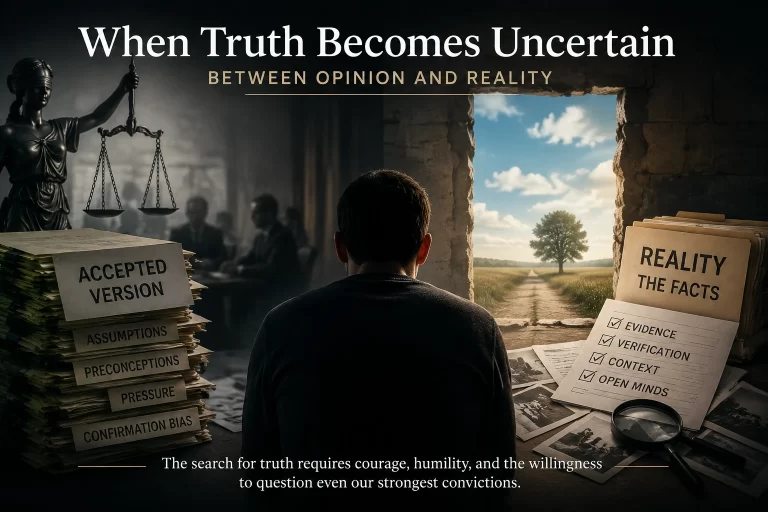
Wanneer de door een systeem aanvaarde werkelijkheid begint af te wijken van wat er werkelijk is gebeurd
When the reality accepted by a system begins to diverge from what actually happened

Page Description
When Truth Becomes Uncertain examines the Liam Allan case and the fragile balance between opinion, evidence, reality, and justice.
When a person becomes the subject of a serious accusation, the justice system has the difficult responsibility of protecting those who may have suffered harm while also ensuring that evidence, not assumptions, determines the outcome.
The most troubling cases are not only about mistakes being made. They are about what happens when an initial assumption becomes so firmly established that reality is no longer properly examined, that the search for the truth is no longer carried out with the necessary openness.
When someone becomes the subject of a serious accusation, the justice system faces the difficult task of protecting those who may have been harmed, while ensuring at the same time that evidence — not assumptions — determines the outcome.
There are situations in which the problem goes even deeper: where a version of events takes on the appearance of reality despite there being little or nothing to support it — or where the event at the centre of the accusation did not happen at all.
At that point, what may appear from the outside to be a functioning process of justice can become something very different: an illusion of justice. The procedures may continue, decisions may be made, and institutions may act within their respective roles, while the foundation on which everything rests is fundamentally wrong.
For the person caught inside such a reality, this is not an abstract question. It can mean years of fear, uncertainty, lost freedom, and excruciating emotional suffering — consequences arising from something that should never have become a reality in the first place.
Wanneer iemand het voorwerp wordt van een ernstige beschuldiging, heeft het rechtssysteem de moeilijke taak om degenen te beschermen die mogelijk schade hebben geleden, en er tegelijkertijd voor te zorgen dat bewijs – en niet veronderstellingen – bepalend is voor de uitkomst.
De meest verontrustende gevallen gaan niet alleen over fouten die worden gemaakt. Ze gaan over wat er gebeurt wanneer een aanvankelijke veronderstelling zo stevig verankerd raakt dat de werkelijkheid niet langer naar behoren wordt onderzocht.
Wanneer iemand het onderwerp wordt van een ernstige beschuldiging, heeft het rechtssysteem de moeilijke taak om degenen te beschermen die mogelijk schade hebben geleden, en er tegelijkertijd voor te zorgen dat bewijs – en niet veronderstellingen – bepalend is voor de uitkomst.
De meest verontrustende gevallen gaan niet alleen over fouten die worden gemaakt. Ze gaan over wat er gebeurt wanneer een aanvankelijke veronderstelling zo stevig verankerd raakt dat de werkelijkheid niet langer naar behoren wordt onderzocht.
Er zijn situaties waarin het probleem nog dieper gaat: waarin een bepaalde voorstelling van de gebeurtenissen de schijn van werkelijkheid krijgt, ondanks het feit dat er weinig of niets is om die te ondersteunen — of waarin de gebeurtenis waarop de beschuldiging is gebaseerd helemaal niet heeft plaatsgevonden.
Op dat moment kan wat van buitenaf lijkt op een goed functionerend proces van rechtspraak iets heel anders worden: een illusie van gerechtigheid. De procedures kunnen doorgaan, beslissingen kunnen worden genomen en instellingen kunnen handelen binnen hun eigen verantwoordelijkheden, terwijl de basis waarop alles rust fundamenteel onjuist is.
Voor de persoon die gevangen raakt in zo’n werkelijkheid is dit geen abstracte vraag. Het kan jaren van angst, onzekerheid, verlies van vrijheid en ondraaglijk emotioneel lijden betekenen — gevolgen die voortkomen uit iets dat nooit werkelijkheid had mogen worden.
1 When a System Stops Questioning Its Own Reality
Beyond human error and talking about situations where the problem may become a failure of integrity within a system — where people or institutions have enough information to question what is happening, but do not do so.
That is a different and more serious issue.
There is an important distinction:
- A mistake: someone reaches the wrong conclusion because information was incomplete, misunderstood, or wrongly assessed.
- Systemic failure: a structure, culture, or set of incentives allows errors to continue without sufficient challenge.
- Systemic dishonesty: this suggests that people knowingly hide, distort, or ignore the truth. That is a very strong claim and requires evidence, because it is about intent.
A careful way to express the concern without assuming motives would be:
The most troubling situations are not only about mistakes, but about what happens when a system fails to confront information that challenges its own conclusions. At that point, the issue is no longer just human error, but responsibility and integrity.
Or:
The question is not only who made the first mistake, but who had the opportunity to recognise it and failed to act.
The phrase used — “on your watch” — is actually very important. It points to responsibility after warning signs appear. In any profession with great power over people’s lives, there comes a moment when the duty is not only to continue a process, but to ask: are we still pursuing the truth, or are we protecting the conclusion we already reached?
Wanneer een systeem zijn eigen werkelijkheid niet langer in vraag stelt
Naast menselijke fouten gaat het hier over situaties waarin het probleem mogelijk dieper ligt: een aantasting van de integriteit binnen een systeem — waarbij mensen of instellingen over voldoende informatie beschikken om wat er gebeurt in vraag te stellen, maar dit niet doen.
Dat is een andere en ernstigere kwestie.
Er bestaat een belangrijk onderscheid:
- Een fout: iemand komt tot een verkeerde conclusie omdat de informatie onvolledig was, verkeerd werd begrepen of verkeerd werd beoordeeld.
- Een systeemfout: een structuur, cultuur of geheel van prikkels maakt het mogelijk dat fouten blijven voortbestaan zonder dat ze voldoende worden uitgedaagd.
- Systemische oneerlijkheid: dit suggereert dat mensen bewust de waarheid verbergen, verdraaien of negeren. Dat is een zeer zware beschuldiging en vereist bewijs, omdat het gaat over intentie.
Een zorgvuldige manier om deze bezorgdheid uit te drukken zonder meteen motieven toe te schrijven:
De meest verontrustende situaties gaan niet alleen over fouten, maar over wat er gebeurt wanneer een systeem nalaat informatie onder ogen te zien die zijn eigen conclusies in twijfel trekt. Op dat moment gaat het niet langer alleen over menselijke fouten, maar over verantwoordelijkheid en integriteit.
Of:
De vraag is niet alleen wie de eerste fout maakte, maar ook wie de kans had om die fout te herkennen en naliet te handelen.
De gebruikte uitdrukking — “on your watch” — is eigenlijk zeer betekenisvol. Ze verwijst naar verantwoordelijkheid op het moment dat waarschuwingssignalen zichtbaar worden.
In elk beroep of elke instelling met grote macht over het leven van mensen komt er een moment waarop de plicht niet alleen bestaat uit het verderzetten van een proces, maar uit het stellen van een fundamentele vraag:
Zijn we nog steeds op zoek naar de waarheid, of beschermen we de conclusie die we al hebben getrokken?

2 The Human Cost When Assumptions Replace Evidence
I Am Not A Rapist | Devastating consequences of False Allegations | TCC
A
E
Liam Allan – Behind the breakthrough: pressure and trauma
6 jun 2019
The publicity around Liam’s case was perhaps the single biggest corner turned so far in the fight against false accusations and police failures.
Liam’s fresh faced appeal gave him a media platform and showed his apparent confidence to the world. Few saw the trauma fears and difficulties that came with presenting his innocent student’s story to TV journalists, and dealing with the reaction.
Now well into the journey of organising a successful series of conferences on the “Innovation of Justice”, Liam’s promise, to never stop fighting to get some return to sanity in the processing of rape/sexual assault cases, has inspired hundreds and made his face well recognised across the world.
A
E

3 When the System Is Challenged From Within
“VERY Clever Woman” | Ex-Post Office Boss “Doesn’t Recall” Being Told About Fault
25 apr 2024 #postoffice #news #talktv
A former top Post Office executive has claimed she forgot about an email in 2010 saying that cash balances in subpostmasters’ branch accounts could be remotely accessed.
Angela van den Bogerd had earlier told the Post Office Horizon IT Inquiry in central London on Thursday that she never “knowingly” did anything wrong in the scandal.
However, Ms van den Bogerd, played by Coronation Street actress Katherine Kelly in the ITV drama Mr Bates vs The Post Office, was asked if she had “airbrushed” from her mind the fact that Horizon developer Fujitsu had remote access to accounts.
Journalist Nick Wallis joins TalkTV’s James Max to discuss thus further.
A
E
UK Post Office Scandal – Vennells vs van den Bogerd: professionalism?
10 jun 2024
** Apologies my microphone was facing the wrong way!. Next video will have amazing sound because I’ll turn the microphone the right way around! But if you think I sound better back to front, let me know in the comments and I’ll keep things as is 🙂 **
I contrast the performances of Paula Vennells and Angelda van den Bogerd at the Post Office Horizon IT Inquiry and reflect on what their behaviour tells us about professionalism. I consider how their particular version of professionalism impacted the UK post office scandal.
00:00 – Start
01:46 – Blaming the Victim: Community and Critical Psychology
02:13 – Paula Vennells: The performance
03:45 – Giving nothing away
05:42 – The meanings of professionalism
08:56 – Is it wrong to be objective?
11:26 – Final word from Sir Wyn Williams
NOTE: In the UK, I am called a ‘Critical Psychologist’. In Australia, which is where I presently live, the title ‘psychologist’ is a protected title used to denote psychologists who are registered with the Australian Health Practitioner Regulation Agency (AHPRA). I am not registered as a psychologist with AHPRA as I am not a qualified health practitioner – I am an academic and social activitist and I do not offer psychological services, I offer critical and political analysis to benefit those working to create progressive social change.
A
E
After Years Studying Law, He Won Freedom For The Innocent And Exposed a Corrupt Judge
A
E
4 When Innocence Has to Fight to Be Heard
How can reality become uncertain when institutions, assumptions, or mistakes determine someone’s fate?
After spending 17 years in prison for a crime he said he did not commit, John Bunn turned his experience into a message of resilience and survival. His music became a way to tell a story that had been ignored for many years: the struggle to be heard when the truth is questioned.
JOHN BUNN x I AIN’T MAD (official video)
A
E