

Game of Thrones (2020) 60 MINUTES reporter Liam Bartlett used to consider the British Royal family to be the masters – and mistresses – of scandal. Now he thinks they may have to hand over their crown to the Belgian Royal family, who have sensationally been ordered to acknowledge and recognise a brand-new princess. However, this decree is not a reason for official celebration on the streets of Brussels because, rather embarrassingly, the new royal is the 52-year-old love child of the former King, Albert II. Back in the 1960s when he was a prince, the supposedly happily married and deeply religious Albert took a long-term lover. Delphine Boel was the surprise consequence of the illicit affair. For most of her life she dutifully kept mum about her lineage, until a bitter falling out with her father changed her mind.
Systemic Injustice: The Enduring Inequalities Embedded in Social, Political, and Legal Systems
Systemisch Onrecht: De Aanhoudende Ongelijkheden Ingebed in Sociale, Politieke en Juridische Systemen
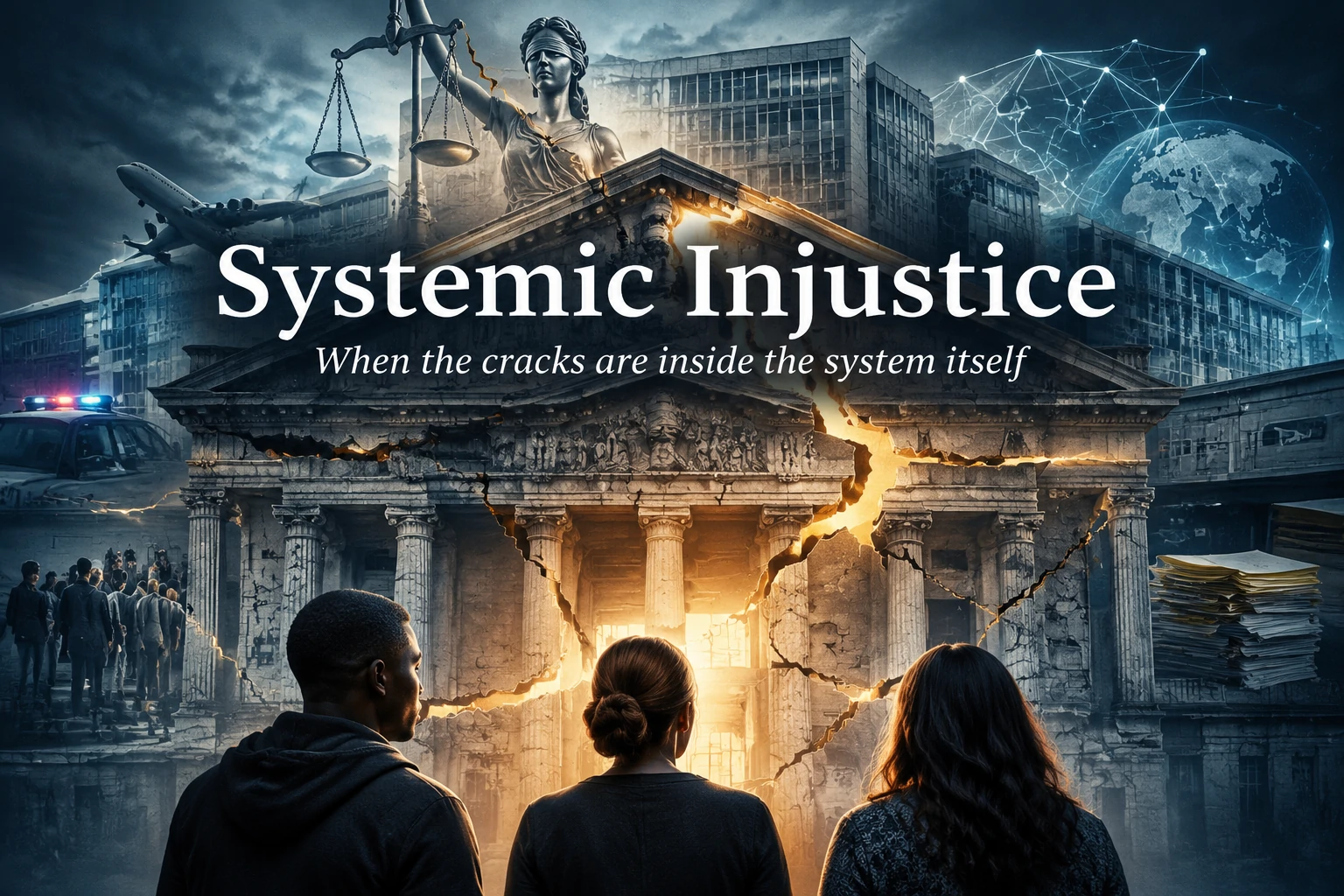
Systemic Injustice
Ingrained unfairness within societal systems that perpetuate inequality and harm, often unintentionally, but with lasting effects on vulnerable groups.
Diepgewortelde oneerlijkheid binnen maatschappelijke systemen die ongelijkheid en schade in stand houden, vaak onbedoeld, maar met blijvende gevolgen voor kwetsbare groepen.
The Vulnerability of Systems: Justice and Technology in Crisis
👉 At the End of the Day, It is the System that Fails
When Technology and Human Error Collide: Flight 447
It is Like the Cracks in the Justice SystemThe Crash of the Entire System
👉 Uiteindelijk is het het Systeem dat Faalt
Wanneer technologie en menselijke fouten samenkomen
De Crash van het Gehele Apparaat
Three Examples to Illustrate the Concept of ‘Systemic Injustice’
a The Cracks in the System
In the justice system, a construct can be put in place that shatters someone’s life, without reason, cause, or justification.
What happened to Air France Flight 447 in May 2009 is a perfect example of ‘The Blind Leading the Blind’ in the justice system.
This Is a Systemic Problem
and the industry has not done anything about it.
May 31, 2009 – 228 lives lost
Air France Flight 447
From Rio de Janeiro to Paris
It is unthinkable that it could just go missing without a word.

A universal definition of “systemic” could be:
“Relating to or affecting an entire system or structure, often used to describe problems that are widespread and deeply embedded within an institution or society.“
For instance, “systemic racism” refers to how racial inequality is embedded in the societal structures, laws, and practices, making it a widespread issue rather than just individual instances of prejudice.
b A Life Shattered: The Tragic Case of Sanda Dia
English
Dutch
English
The tragic case of Sanda Dia highlights the dangers of systemic failure within institutions. In this heartbreaking story, the pursuit of tradition and power led to the senseless loss of a young life. Watch as we uncover the truth behind the events and explore the lasting consequences of ignoring justice.
Dutch
Een leven verwoest: de tragische zaak van Sanda Dia
Het tragische geval van Sanda Dia benadrukt de gevaren van systeemfouten binnen instellingen. In dit hartverscheurende verhaal leidde de zoektocht naar traditie en macht tot het zinloze verlies van een jong leven. Bekijk hoe we de waarheid achter de gebeurtenissen onthullen en de blijvende gevolgen van het negeren van gerechtigheid verkennen.
Essential viewing
Shocking Content

The hazing was not just wrong—it was catastrophic in its disregard for human life, and the failure to intervene when it was clear that Sanda Dia was in distress demonstrates how deeply flawed the system was.
c The Soul-Crushing Effects of Injustice: The Cost of Denied Justice
In a deeply moving video,
Delphine Boël exposes the horrific misuse of justice by King Albert II and his lawyers, shedding light on the personal toll of systemic abuse.
In summary: The seven years that Princess Delphine fought were a testament to everything she could do, especially considering that King Albert II went to cassation twice, forcing the court to impose a fine of €5,000 per day to compel him to provide his DNA. Princess Delphine also stated, ‘Albert and his lawyers were horrible.’
The Secret Princess: King’s love child in court battle for recognition | 60 Minutes Australia
11 okt. 2020
For forty years, 60 Minutes have been telling Australians the world’s greatest stories. Tales that changed history, our nation and our lives. Reporters Liz Hayes, Tom Steinfort, Tara Brown, Liam Bartlett and Sarah Abo look past the headlines because there is always a bigger picture. Sundays are for 60 Minutes.
English
Dutch
English
A daughter denied
For years, Delphine Boël lived in the shadows of a hidden truth — the daughter of Belgium’s King Albert II, yet unacknowledged by law or title. This documentary by 60 Minutes Australia follows her powerful legal and emotional journey toward recognition.
It’s not just a royal story — it’s a human one. A quiet but relentless search for truth, dignity, and justice.
Dutch
De verpletterende effecten van onrechtvaardigheid: de prijs van geweigerde gerechtigheid
Een dochter ontkend
Jarenlang leefde Delphine Boël in de schaduw van een verzwegen waarheid — als dochter van koning Albert II van België, maar zonder wettelijke erkenning of titel. Deze documentaire van 60 Minutes Australia volgt haar indrukwekkende juridische en persoonlijke strijd voor erkenning.
Het is niet alleen een koninklijk verhaal — het is een menselijk verhaal. Een stille maar vastberaden zoektocht naar waarheid, waardigheid en gerechtigheid.
d The Tide Turns When King Albert Is Compelled by the Court to Provide His DNA
This moment came after seven years during which the king and his top lawyers did everything possible to avoid it. Then, as if struck by a thunderclap on a clear day, the king’s long-awaited response came—especially considering that King Albert II had a 18-year extramarital relationship with Delphine’s mother!
According to Delphine in the video ‘The Secret Princess: King’s love child in court battle for recognition | 60 Minutes Australia’, King Albert and her mother were best friends, spending hours on the phone together. They also went on holidays as a trio, often preferring to travel on his boat to avoid being seen.
Explore how the justice system can become a life-altering force in
[The Die is Cast: On Human Nature and the Pursuit of Justice],
where we discuss the inevitable consequences once you enter its grip.
e Systemic Injustice: The Fault Lies in the System, Not the People
By highlighting these examples (1.a, b, and c), I aim to illustrate how systemic injustice is not just about occasional wrong decisions, but about the culture and structures in place that allow these failures to continue unchecked.
- Whether it’s a tragic accident,
- a life shattered by institutional neglect,
- or a personal battle for justice,
these cases show us how deeply rooted and far-reaching systemic issues can be.
The link Raise Eyebrows to the video about Ryan Ferguson
Both videos, about Ryan Ferguson and Flight 447, are incredibly strong in portraying how deeply ingrained these injustices are—and they make the meaning of ‘Systemic Injustice’ resonate far more clearly in the viewer’s mind. The powerful storytelling in these videos truly prepares the audience to understand the full weight of systemic failures.
“The eye doesn’t see what the mind doesn’t know.”
In Conclusion:
Systemic Injustice: When Honesty Disappears, the Gap Widens
English
Dutch
English
When honesty disappears, it creates a vacuum where all sorts of wrongs can slip through unnoticed, especially in systems. That’s one of the core aspects of systemic injustice: the absence of accountability or transparency leaves room for exploitation, inequality, and corruption.
The header focuses on the cause (the loss of honesty) and the effect (the widening of systemic issues). It also aligns with the idea of how systemic failures can spiral.
Without honesty, systems become fertile ground for abuses. At the heart of systemic issues is the absence of honesty, which allows failure, exploitation, and corruption to spread unchecked.
The key takeaway might be that in each case, the individual is not the problem, but rather the larger system is the root cause of the injustice, and those affected are often left to fight it alone.
That core idea really ties everything together: it’s not the individual who’s at fault, but the system that enables and perpetuates injustice. In each case, the person affected is up against something much larger—something that often remains hidden or unchallenged. It’s a powerful way to frame the situation and make it clear that these aren’t just “one-off” mistakes, but part of a much bigger and deeper issue.
Dutch
Systemisch Onrecht: Wanneer Eerlijkheid Verdwijnt, Ontstaat de Kloof
Wanneer eerlijkheid verdwijnt, creëert het een vacuüm waar allerlei onrecht ongemerkt doorheen kan glippen, vooral binnen systemen. Dit is een van de kernaspecten van systemisch onrecht: het ontbreken van verantwoording en transparantie biedt ruimte voor uitbuiting, ongelijkheid en corruptie.
De kop richt zich op de oorzaak (het verlies van eerlijkheid) en het effect (de ontstaan van systemische problemen). Het sluit ook aan bij het idee van hoe systemische mislukkingen kunnen escaleren.
Zonder eerlijkheid worden systemen een vruchtbare bodem voor misbruiken. Het hart van systemische problemen is het ontbreken van eerlijkheid, waardoor falen, uitbuiting en corruptie ongecontroleerd kunnen verspreiden.
De belangrijkste conclusie is misschien wel dat in elk geval niet het individu het probleem is, maar dat het grotere systeem de hoofdoorzaak is van het onrecht, en dat de getroffenen vaak alleen staan in hun strijd hiertegen.
Die kerngedachte verbindt alles met elkaar: het is niet de persoon die schuldig is, maar het systeem dat onrechtvaardigheid mogelijk maakt en in stand houdt. In elk geval heeft de getroffen persoon te maken met iets veel groters – iets dat vaak verborgen blijft of niet wordt aangevochten. Het is een krachtige manier om de situatie te kaderen en duidelijk te maken dat dit niet zomaar “incidentele” fouten zijn, maar deel uitmaken van een veel groter en dieper liggend probleem.
Systemic Injustice: From Exploitation to Governmental Failure
English
Dutch
English
Jeffrey Epstein and the British Post Office Scandal
Both of these cases reflect issues of corruption, exploitation, and systemic failures that were allowed to persist for years, harming countless individuals.
In these cases, the system (whether it’s the legal system, corporate interests, or governmental structures) is the real source of the injustice, not the individuals caught in its web.
-
Jeffrey Epstein: A case where an entire network of powerful people exploited vulnerable individuals, and the system—whether it’s law enforcement, the justice system, or the media—allowed the abuse to continue for decades.
-
British Post Office Scandal: Where a flawed IT system led to innocent Subpostmasters being wrongfully accused and convicted of theft, with the system (Post Office management, the legal system, and even the government) refusing to acknowledge the failures that caused it.
De Kinderopvangtoeslagaffaire (The Childcare Benefits Scandal)
This scandal, which shocked many in the Netherlands, is a clear example of systemic injustice in a government system, where families—especially from lower-income and immigrant backgrounds—were wrongly accused of fraud over childcare benefits. Thousands of families were wrongfully investigated, had their benefits cut, and suffered immense emotional and financial strain.
What makes this different from some of the other examples (like Epstein or the Post Office) is that the injustice wasn’t about a group of individuals exploiting others, but rather a state-run system that overzealously targeted people, often without evidence or clear reasoning. The Dutch government’s failure to acknowledge its role and the depth of the damage created a situation where the system itself failed the people it was supposed to protect.
Different Perceptions of Systemic Problems in These Contexts
While all three examples—Epstein, the British Post Office, and the Dutch childcare benefits scandal—are clearly systemic issues, the public perception might differ. In the case of Epstein, the focus is often on the individuals and their abuse of power. The Post Office scandal focuses on a corporate failure and legal injustice. But with the Dutch childcare benefits scandal, it was a governmental mishandling of policies that left ordinary citizens (especially vulnerable families) to bear the brunt of the injustice.
Dutch
Systemisch Onrecht: Van Exploitatie tot Overheidsfalen
Jeffrey Epstein en het Britse Post Office Schandaal
Beide gevallen weerspiegelen kwesties van corruptie, uitbuiting en systemische mislukkingen die jarenlang hebben kunnen voortduren, waardoor talloze mensen schade hebben geleden.
In deze gevallen is het systeem (of het nu het rechtssysteem, bedrijfsmatige belangen of overheidsstructuren zijn) de werkelijke bron van het onrecht, niet de individuen die in de val zijn gelopen.
Jeffrey Epstein:
Een geval waarbij een heel netwerk van machtige mensen kwetsbare individuen uitbuitte, en het systeem—of het nu wetshandhaving, het rechtssysteem of de media was—het misbruik jarenlang mogelijk maakte.
Het Britse Post Office Schandaal:
Waar een gebrekkig IT-systeem leidde tot de onterechte beschuldiging en veroordeling van onschuldige subpostmeesters voor diefstal, waarbij het systeem (de Post Office-directie, het rechtssysteem en zelfs de regering) weigerde de fouten die dit veroorzaakten te erkennen.
De Kinderopvangtoeslagaffaire
Dit schandaal, dat veel mensen in Nederland shockeerde, is een duidelijk voorbeeld van systemisch onrecht binnen een overheidsysteem, waarbij gezinnen—vooral uit lagere inkomensgroepen en immigrantenachtergronden—onterecht beschuldigd werden van fraude met kinderopvangtoeslagen. Duizenden gezinnen werden onterecht onderzocht, hun toeslagen werden stopgezet en ze leden enorme emotionele en financiële schade.
Wat dit anders maakt dan sommige van de andere voorbeelden (zoals Epstein of het Post Office), is dat het onrecht niet werd veroorzaakt door een groep individuen die anderen uitbuitten, maar eerder door een overheidsysteem dat mensen overmatig targette, vaak zonder bewijs of duidelijke reden. Het falen van de Nederlandse overheid om haar rol te erkennen en de diepte van de schade te begrijpen, creëerde een situatie waarin het systeem zelf de mensen die het moest beschermen, in de steek liet.
Verschillende Percepties van Systemische Problemen in Deze Contexten
Hoewel alle drie de voorbeelden—Epstein, het Britse Post Office en het Nederlandse kinderopvangtoeslagschandaal—duidelijk systemische kwesties zijn, kan de publieke perceptie ervan verschillen. In het geval van Epstein ligt de focus vaak op de individuen en hun misbruik van macht. Het Post Office schandaal richt zich op een bedrijfsfaling en juridische onrechtvaardigheid. Maar met het Nederlandse kinderopvangtoeslagschandaal was het een overheidsfalen in het beleid dat gewone burgers (vooral kwetsbare gezinnen) de dupe maakte van het onrecht.

English
Dutch
English
This might be an interesting distinction to make. Systemic injustice can affect people in very different ways: sometimes it’s corporate greed, sometimes it’s governmental failure, or sometimes it’s the failure of entire systems of law and order. But in all these cases, the individual becomes the scapegoat for a failure they didn’t cause, and the system that allowed these injustices to continue often remains protected.
Dutch
Een interessante tegenstelling om te maken. Systemisch onrecht kan mensen op verschillende manieren beïnvloeden: soms gaat het om bedrijfshebzucht, soms om overheidsfalen, of soms om het falen van gehele rechts- en ordeningssystemen. Maar in al deze gevallen wordt het individu de zondebok voor een falen waar ze zelf niets aan kunnen doen, terwijl het systeem dat deze onrechtvaardigheden mogelijk maakte, vaak beschermd blijft.
Trapped in a Dysfunctional Environment: The Faces of Systemic Injustice
English
Dutch
English
Systemic injustice manifests in various ways, often tied to corporate greed, governmental failures, or the breakdown of entire legal systems. In each of these cases, individuals become scapegoats, bearing the consequences of failures they didn’t cause. Meanwhile, the very systems that perpetuate these injustices often remain shielded from accountability.
In essence, you can say that someone becomes a subject of the environment in which they are trapped. This is a pattern that repeats across a wide range of situations:
Diederik Stapel, a professor caught in the web of his own academic deceit, illustrates how even in the world of science, individuals can be consumed by the system they operate within, trapped by the very pressures that drive unethical behavior.
Bernie Madoff’s Ponzi scheme victimized countless investors, but it was the systemic corruption and oversight failures that allowed such an enormous fraud to persist undetected for so long.
The Zeebrugge ferry disaster, where hundreds lost their lives due to corporate negligence, is another stark example of how systemic failure leads to tragic outcomes. The Free Enterprise ferry tragedy is a reminder that corporate entities, in their pursuit of profit, often fail to uphold basic safety standards.
The disappearance of Air France Flight 447 from Rio to Paris on May 31, 2009, is another instance where individuals found themselves victims of an environment where oversight and responsibility fell short. The tragedy of 228 lives lost seems unthinkable in our modern, technology-driven world, yet it went missing without any immediate explanation.
These examples share a common thread: the individuals involved were not the cause of the failures that led to their victimization. They were caught in the gears of a broken system, where the failure of oversight, accountability, and integrity created a perfect storm for systemic injustice.
Dutch
Verstrikt in een Dysfonctionele Omgeving: De Gezichten van Systemische Onrechtvaardigheid
Systemische onrechtvaardigheid manifesteert zich op verschillende manieren, vaak door corporate hebzucht, falen van de overheid of de ondergang van hele rechtssystemen. In al deze gevallen worden individuen zondebokken, die de gevolgen dragen van mislukkingen die zij niet hebben veroorzaakt. Ondertussen blijft het systeem dat deze onrechtvaardigheden mogelijk maakte vaak onbeschermd voor verantwoordelijkheid.
In wezen kun je zeggen dat iemand het onderwerp wordt van de omgeving waarin hij gevangen zit. Dit is een patroon dat zich herhaalt in verschillende situaties:
Diederik Stapel, een professor die verstrikt raakte in zijn eigen academische bedrog, laat zien hoe zelfs in de wetenschappelijke wereld individuen verzwolgen kunnen worden door het systeem waarin ze opereren, gevangen door de druk die hen ertoe aanzet onethisch gedrag te vertonen.
Bernie Madoff’s Ponzi-schema bedrogen talloze investeerders, maar het was het systemische corruptie en het falen van het toezicht dat een enorme fraude zo lang onopgemerkt liet voortduren.
De Zeebrugge-ferryramp, waarbij honderden mensen omkwamen door corporale nalatigheid, is een ander schrijnend voorbeeld van hoe systemische falen leidt tot tragische uitkomsten. De tragedie van de Free Enterprise-ferry herinnert ons eraan dat bedrijven, in hun streven naar winst, vaak in gebreke blijven bij het handhaven van de basisveiligheidsnormen.
Het verdwijnen van Air France vlucht 447 van Rio naar Parijs op 31 mei 2009 is een ander geval waarin individuen slachtoffers werden van een omgeving waar toezicht en verantwoordelijkheid tekortschoten. De tragedie van 228 verloren levens lijkt ondenkbaar in onze moderne, door technologie gedreven wereld, en toch verdween het zonder enige onmiddellijke uitleg.
Deze voorbeelden delen een gemeenschappelijk kenmerk: de betrokkenen waren niet de oorzaak van de mislukkingen die tot hun slachtofferschap leidden. Ze waren gevangen in de tandwielen van een gebroken systeem, waarbij het falen van toezicht, verantwoordelijkheid en integriteit een perfecte storm creëerde voor systemische onrechtvaardigheid.

Page Description
Examine systemic injustice through the cases of Flight 447, Sanda Dia, and Princess Delphine, showing how societal systems perpetuate harm and inequality.
Systemic Injustice: The Hyacinth Bucket Effect—Keeping Up Appearances at All Costs
Keeping Up Appearances 1994 Christmas Special | Keeping Up Appearances | BBC Comedy Greats

English
Dutch
English
A
Dutch
E