
10 mei 2026 #HannahArendt #Psychology #TheLucidMind
We tell ourselves a story about evil.
The story goes like this: terrible things are done by terrible people. People who are fundamentally different from the rest of us — twisted, broken, driven by something we don’t have. When something horrific happens, we look for the monster responsible. We need there to be a monster. Because if there is a monster, then the rest of us are safe.
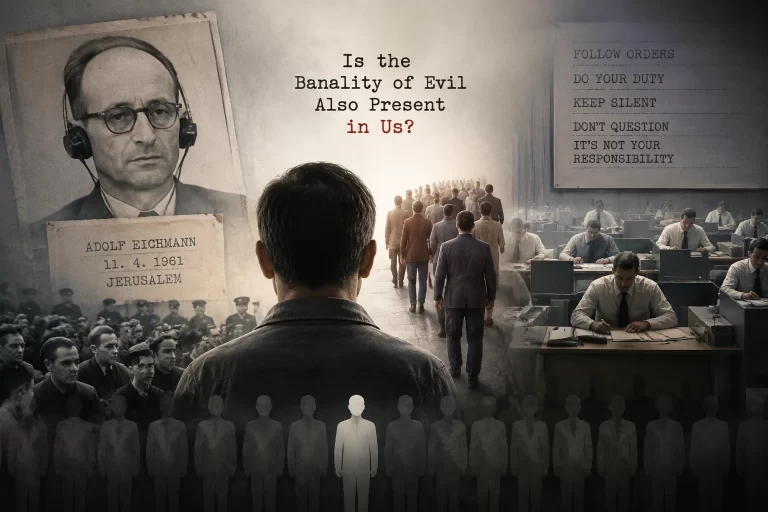
Hannah Arendt went to the trial of Adolf Eichmann — one of the primary architects of the Holocaust — expecting to see that monster. What she found was a bureaucrat. A man who spoke in clichés, who could not produce a single original thought, who kept explaining that he had always done his duty, always followed orders, always been a good employee. He was not a monster. He was, in her words, terrifyingly normal.
She called it the banality of evil. And she meant something very precise: evil does not require anything extraordinary in the person who does it. It requires only thoughtlessness — the inability to think from the standpoint of anyone other than yourself.
In this video, you will understand what Arendt actually meant, why it made people so furious, and why it matters for how you understand your own capacity for harm and your own capacity for beginning again. You will learn:
• What made Eichmann terrifying — and why it wasn’t what anyone expected
• What thoughtlessness actually means: not stupidity, not ignorance, but the specific inability to register that other people are genuinely real
• The concept of plurality — what it is, why it is always under threat, and what happens when it is lost
• Why thinking is itself a form of moral resistance — and why systems are often designed to make it unnecessary
• Forgiveness and the promise as the two human capacities that make beginning again possible
• Natality — Arendt’s most hopeful concept: the capacity every person has to introduce something genuinely new
This is not a video about history. It is a video about what thoughtlessness looks like in ordinary life — and what it means to choose to think.
⏱ CHAPTERS
00:00 The Story We Tell About Evil
01:06 Hannah Arendt — From Berlin to Jerusalem
03:58 What Thoughtlessness Actually Means
05:47 Plurality
07:32 Thinking as Resistance
09:22 Forgiveness and Promise
11:24 Natality
13:21 One Practice
14:56 What She Left Behind
📚 Referenced: Eichmann in Jerusalem (1963), The Human Condition (1958) — Hannah Arendt
Think about a moment when you did something that hurt someone — not because you were cruel, but because you simply didn’t think about what it was like to be them. Leave it in the comments if you’re willing. The banality is not a historical concept. It is available right now. Subscribe to The Lucid Mind. Because this is exactly the kind of question we should be sitting with.

Candle in the wind
Now you belong to heaven, and the stars spell out your name Goodbye England’s rose;
may you ever grow in our hearts.
You were the grace that placed itself
where lives were torn apart.
You called out to our country,
and you whispered to those in pain.
Now you belong to heaven,
and the stars spell out your name.And it seems to me you lived your life
like a candle in the wind:
never fading with the sunset
when the rain set in.
And your footsteps will always fall here,
among England’s greenest hills;
your candle’s burned out long before
your legend ever will.Loveliness we’ve lost;
these empty days without your smile.
This torch we’ll always carry
for our nation’s golden child.
And even though we try,
the truth brings us to tears;
all our words cannot express
the joy you brought us through the years.Goodbye England’s rose,
from a country lost without your soul,
who’ll miss the wings of your compassion
more than you’ll ever know.Copyright DJM Music

Candle in the wind
Nu behoor je tot de hemel, en de sterren schrijven jouw naam. Vaarwel, roos van Engeland;
moge je voor altijd blijven groeien in onze harten.
Jij was de gratie die zich bevond
waar levens uit elkaar waren gevallen.
Je richtte je tot ons land,
en je fluisterde woorden tot hen die pijn leden.
Nu behoor je tot de hemel,
en de sterren schrijven jouw naam.En het lijkt mij dat jij je leven leefde
als een kaars in de wind:
nooit vervagend met de ondergaande zon,
zelfs niet toen de regen kwam.
En jouw voetstappen zullen hier altijd blijven,
tussen de groenste heuvels van Engeland;
jouw kaars is lang geleden gedoofd,
maar jouw legende zal dat nooit doen.De schoonheid die we verloren hebben;
deze lege dagen zonder jouw glimlach.
Deze fakkel zullen wij altijd dragen
voor het gouden kind van onze natie.
En hoewel we het proberen,
brengt de waarheid ons tot tranen;
al onze woorden kunnen niet uitdrukken
hoeveel vreugde jij ons door de jaren heen hebt gebracht.Vaarwel, roos van Engeland,
van een land dat verloren lijkt zonder jouw ziel,
dat de vleugels van jouw mededogen zal missen
meer dan jij ooit zult beseffen.

In première gegaan op 15 jun 2020 #americasgottalent #agt #audition
Archie Williams – Wrongly Convicted for 37 years Delivers Incredible Song – America’s Got Talent 2020
Please Like, Share, Comment and Subscribe to my Channel..
Archie Williams was sentenced to life of prison for a crime that he didn’t commit. After 37 years DNA sets him free. Archie sings an emotional rendition of Don’t let the sun go down on me.
